
High Value/Low Volume (HVLV) manufacturing has always been a proving ground for engineering excellence. These organisations design and build highly specialised equipment and assets that often define the performance of entire operations. Yet, while the engineering and design functions within HVLV businesses have evolved dramatically in the past decade, customer support models have not kept pace.
And that imbalance is beginning to show.
Today’s HVLV manufacturers doesn’t merely ship a product. They ship a promise: that the expertise invested in creating a high-value asset is matched by the expertise available to support it, anywhere in the world, for the entirety of its lifecycle.
Increasingly, the question facing boards and senior leadership is not: “Should we modernise our support model?” but rather: “What happens if we don’t?”
The Strategic Reality: Expertise Is Becoming the Product
In HVLV markets, equipment differentiation is narrowing. Engineering excellence is assumed. Quality is expected. And competitors are catching up faster than ever. Where differentiation is emerging today is in the experience surrounding the product:
The responsiveness of support
The quality of knowledge transfer
The ability to diagnose and resolve issues rapidly
The continuity of expertise throughout the lifecycle
The confidence customers feel when operating highly advanced systems
In other words, expertise itself has become an essential part of the value proposition. Yet most HVLV manufacturers are still relying on legacy support structures built for a world when assets were simpler, travel was cheaper, and digital maturity was lower. These old models were never designed for:
Geographically dispersed customers
Increasingly digitalised equipment
Talent shortages
The expectation of “immediate expertise” as standard
Senior leaders now face a strategic imperative: if a product commands a seven-figure price tag, the support model must demonstrate seven-figure sophistication.
The Hidden Economics of Expertise Leakage
Every HVLV manufacturer recognises the importance of their most experienced engineers, yet few have fully quantified the economic impact when their expertise becomes a bottleneck. Companies in this sector are increasingly exposed to three compounding challenges:
1. Expertise concentration: A small group of engineers often holds tacit knowledge that cannot be easily replicated or transferred. When they are unavailable, customer experience suffers, and uptime drops.
2. Knowledge drift: Over time, documentation, training programmes, and manuals fall out of sync with operational reality. The product evolves faster than the support model.
3. Cost of interpretation: Without shared context (the ability to “see what I see”), remote conversations become slower and less precise. This increases downtime and erodes customer trust.
The result? A growing gap between product sophistication and support sophistication. Left unaddressed, this gap becomes a competitive liability.
Global Customers Expect Global Expertise Instantly
Across industries from energy to aerospace to automotive supply chains, customers are becoming less tolerant of slow support. The HVLV buyer today is often a multibillion-pound enterprise with global operations.
They expect:
Response times measured in minutes
Direct access to senior engineers
Seamless operational continuity
Data-driven insights
A support model that does not fail when borders, bandwidth, or schedules get in the way
This expectation isn’t unreasonable. It’s consistent with what they experience everywhere else: real-time remote collaboration, instant access to information, and highly personalised service. And if a manufacturer cannot meet this standard, customers will look for one that can.
The New Support Mandate: Context, Continuity, and Capability
Modern HVLV support must evolve from a reactive function into a strategic extension of the engineering organisation. This requires solving a problem that has historically seemed intractable: How do you transmit expert-level understanding across distance, time zones, and variable conditions? The answer is not “more documentation.” Not “more training.” Not “more people.” It is an operational architecture that delivers three things:
1. Context: Experts must see precisely what the frontline sees. Interpretation must be replaced with shared situational awareness.
2. Continuity: Knowledge must persist beyond individual engineers captured, and made usable for both internal teams and customers.
3. Capability: Frontline workers must be empowered to act with confidence, even when the asset is complex, customised, or digitally enhanced.
This is the new standard. And it is rapidly becoming the baseline expectation across HVLV sectors.
AR-Enabled Support Is Not a “Technology Bet” It’s Structural Modernisation
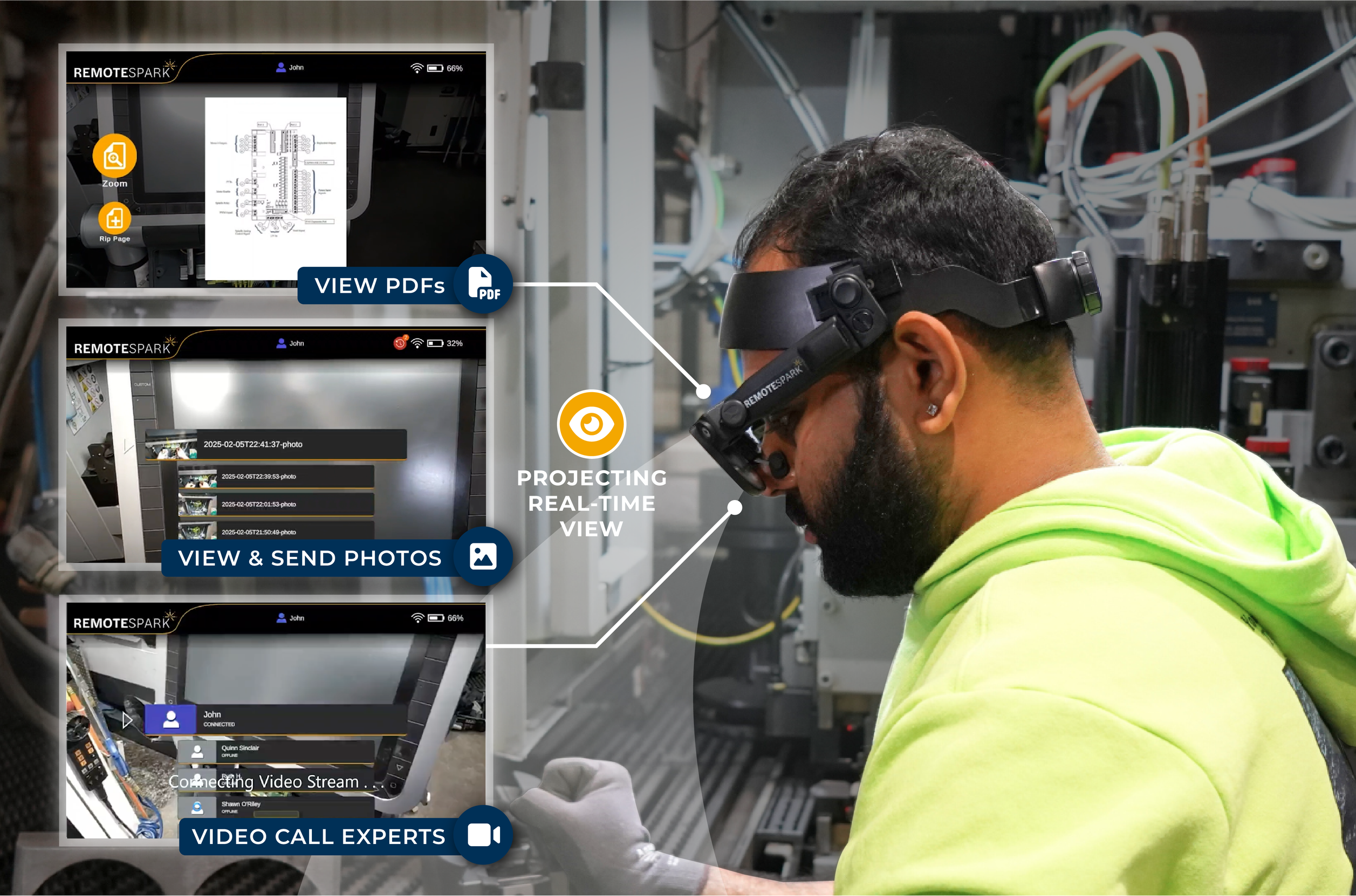
Augmented reality should no longer be regarded as an interesting tool or an optional enhancement to existing support processes. It represents a fundamental shift in how expert knowledge is captured, distributed, and applied across an organisation. AR democratises access to an organisation’s top-tier expertise, ensuring frontline teams regardless of geography, receive the same high-quality guidance without waiting for travel or specialist availability. It mitigates operational risk by reducing dependency on a small number of highly skilled individuals, and it lifts first-time fix rates by giving experts real-time visual context rather than relying on interpretation over phone or email. At the same time, AR support solutions can create a contextual record of maintenance activity, strengthening traceability and accelerating organisational learning. It expands the effective reach of customer support teams, enhances training by embedding instruction within real-world workflows, and enables manufacturers to deliver consistent service even when operating in regions with limited bandwidth or challenging environments. In doing so, AR aligns support operations with the increasing sophistication of HVLV assets, ensuring that as products become more advanced, the capability to support them advances in parallel.
HVLV Manufacturers That Adopt Modern Support Models Will Lead the Next Decade
The HVLV organisations that will shape the next decade are those that recognise customer support as a strategic differentiator rather than a cost obligation. These manufacturers will provide expertise at the speed their customers expect, safeguarding the uptime of high-value assets and ensuring operational continuity across global deployments. They will cultivate confident, capable workforces internally and across customer sites through consistent access to expert knowledge and real-time guidance. They will forge deeper, more resilient client relationships by demonstrating reliability not only in the equipment they deliver, but in the support ecosystem that surrounds it. Crucially, they will capture and preserve organisational knowledge rather than allowing it to dissipate as senior engineers move roles or retire, reducing both talent risk and operational fragility. And by strengthening the support experience throughout the entire lifecycle of the product, they enhance the long-term value customers derive from every asset. Above all, these manufacturers will earn and sustain trust, a currency that carries extraordinary weight in the high-stakes world of HVLV manufacturing.
A Final Thought for Leaders
Over the next five years, every HVLV manufacturer will face a choice. Some will continue to rely on traditional, travel-dependent support structures, structures that are increasingly incompatible with modern customer expectations. Others will modernise their operational architecture, ensuring that expertise flows as freely as the products they engineer. The first group will struggle. The second will lead.
If your organisation is ready to move into that second category, I’d welcome a conversation. We can show you how leading HVLV manufacturers are transforming their support strategy, and how RemoteSpark can help your organisation do the same.
